Forward-facing in a baby carrier: when to start and for how long
12 novembre 2026
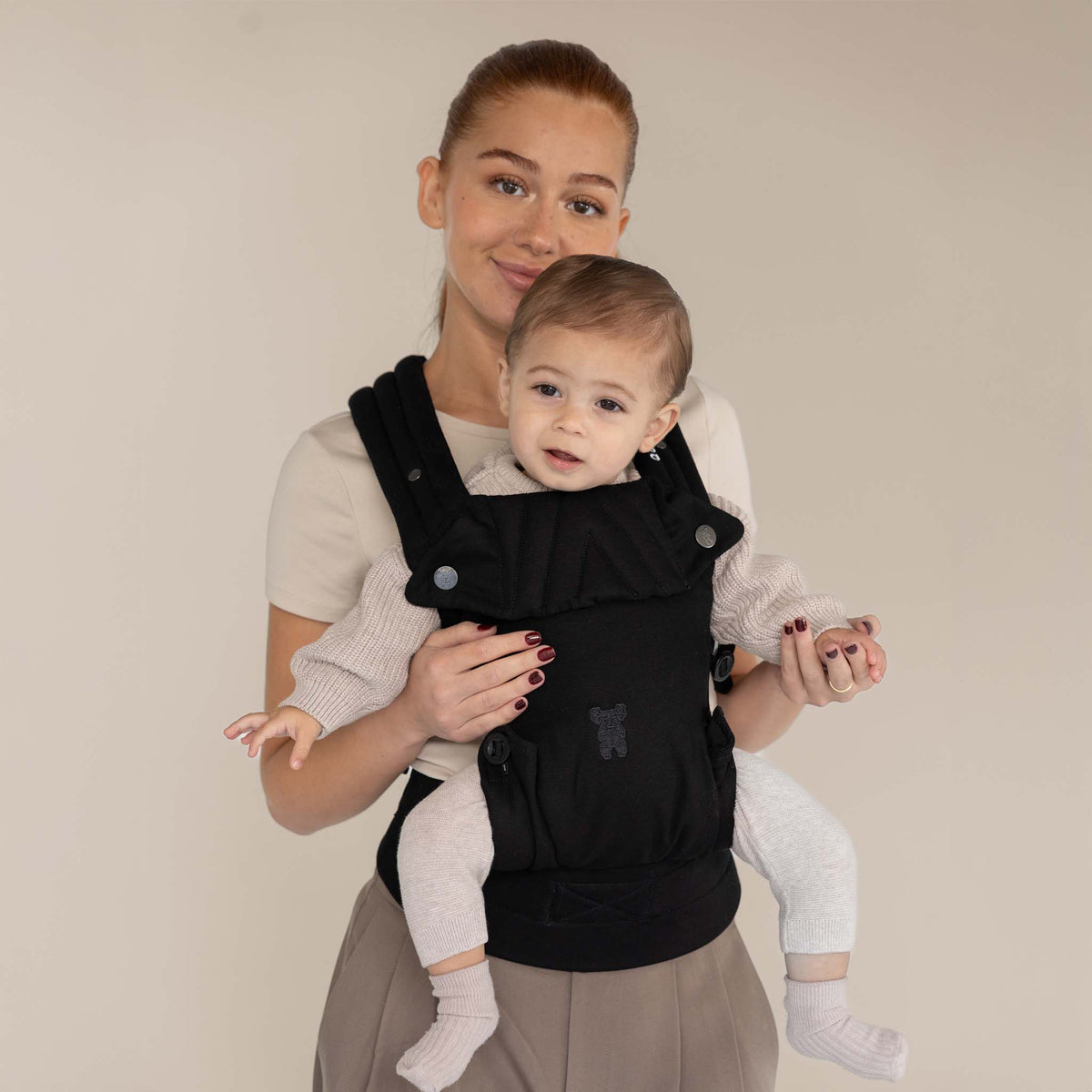
One day you notice it. Your baby is facing you in the carrier, but keeps turning their head to the side to see what is going on. That is usually when the question comes up: can they face forward now? And if so, for how long?
When can a baby face forward in a carrier?
Most babies are ready at around 6 months. There is no set date. It depends on what your baby can do:
- Good head control. Their head stays steady when you walk or bend down for a moment.
- They like sitting upright. On your lap or in a high chair, they want to look around.
- They fit this position. Their face is above the top of the carrier and they don't slump down.
Not sure if your baby is ready? Ask your midwife or health visitor. Waiting a bit longer is always fine. Carrying your baby facing you is still lovely after 6 months.
How long can a baby face forward?
There isn't a fixed number of minutes. Facing out, your baby sees a lot more: people, bikes, dogs, the lights in the shop. That's exciting, and it's also a lot to take in. They also can't turn and snuggle into you when it gets too much.
So start with short stretches, like a walk around the block or a quick trip to the shop. Watch how your baby reacts. If it goes well, you can make it a little longer each time.
These are often signs that it's been enough:
- They keep looking away or turning their head to the side.
- They get fussy, start to grizzle or rub their eyes.
- They go quiet and stare into space.
Then turn them around to face you. They can lean against you and have a break. If your baby is tired or you're somewhere busy, facing you is usually the nicer position.
How to check the forward-facing position
Facing out, you still keep an eye on how your baby sits. The first few times, have a quick look in the mirror.
- High enough. The top of their head is roughly under your chin. If they hang low at your tummy, tighten the shoulder straps a little.
- Thighs supported. The seat supports their thighs and the lower legs hang free.
- Face clear. No fabric over their nose or mouth.
- Snug against you. There's no gap between their back and your body.
The Solace Carrier has buttons on the inside to adjust it for forward-facing carrying. The manual shows you step by step how to do it. You set the width of the seat with hidden velcro tabs, so it fits your baby's size.
What you'll notice
Facing forward, your baby sits a little further away from your body. Many parents find it feels heavier because of that, mostly in the lower back and shoulders. Fasten the waist belt firmly around your hips so a good part of the weight rests there, then adjust the shoulder straps.
It's also harder to give them a kiss on the head. A hand on their tummy or simply talking to them works well too. They hear your voice and feel you close by.
Later on: carrying on your back
As your little one gets bigger and heavier, carrying on your back is often more comfortable for longer walks. You can do that from around 12 months. They look out over your shoulder and the weight sits closer to your body.
The Solace Carrier has three carrying positions: facing you from birth, facing forward from around 6 months and on your back from around 12 months. It fits from 3.2 to 15 kg, roughly up to age 3.
"This purchase was amongst the best that we did for our little one. It is both comfortable for us and for our baby."
Magdalena M., review on Judge.me
Just give it a go
The first time facing forward takes some getting used to for both of you. Pick a quiet moment when your baby has been fed and is in a good mood. If they don't like it yet, try again in a few weeks.
You can try the Solace Carrier at home for 30 days, with your baby too. It is acknowledged as hip-healthy by the IHDI.