The M position in a baby carrier: what it is and how to check it
4 novembre 2026
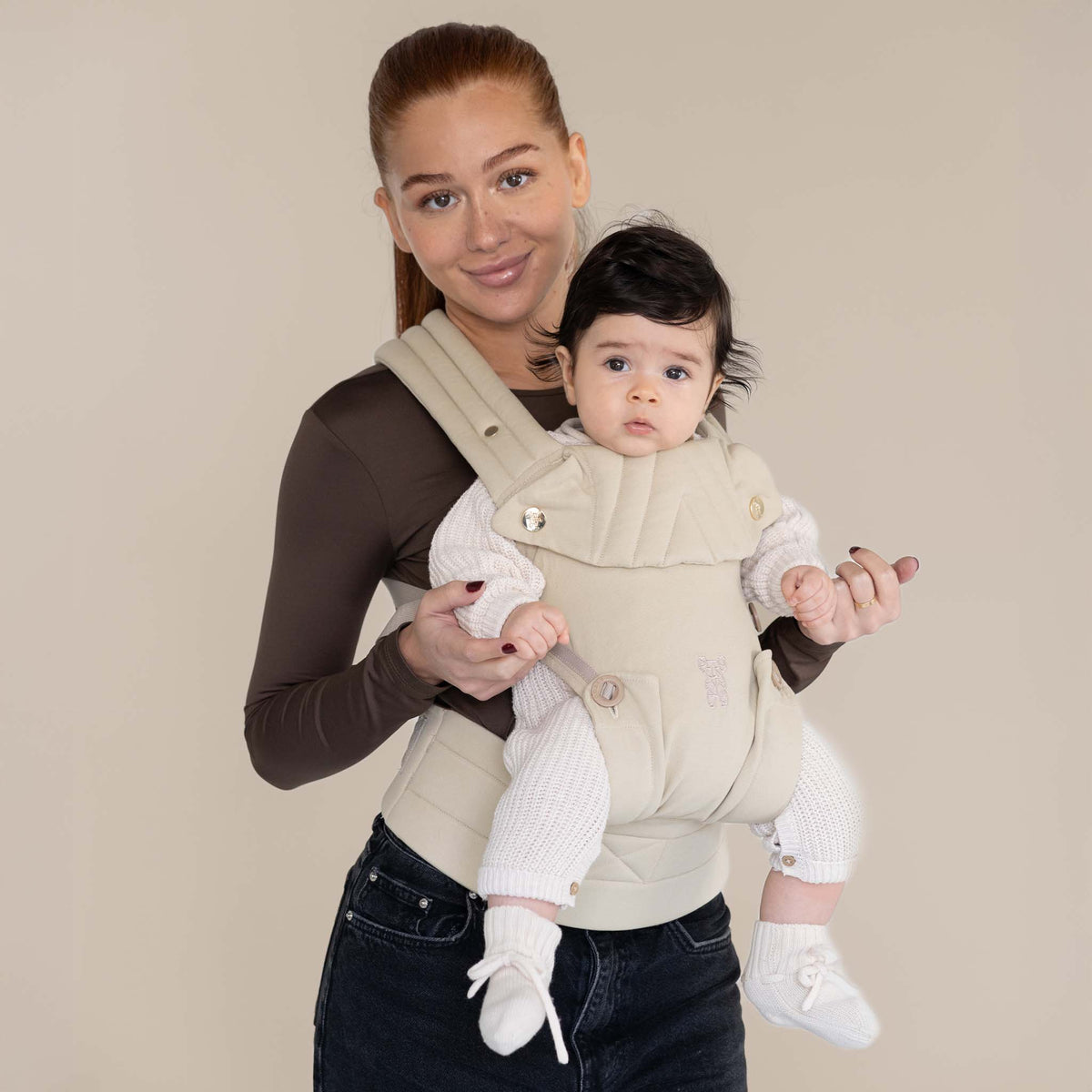
Once you start looking at baby carriers, you see it everywhere: the M position. Your midwife may have mentioned it already, and every carrier says it gets it right. So what is it exactly, and how can you tell if your own baby is sitting well?
What is the M position?
In the M position, your baby's knees sit a little higher than their bottom and their legs are spread wide. Looking from the front, you see an M: knee, bottom, knee. Their back is gently rounded.
It's the position a baby takes on their own when you pick them up and hold them against your shoulder. They pull their legs up and spread them around you. A good carrier follows that shape.
You may also see it called the spread-squat position, or the "frog" position.
Why babywearing consultants look for it
A baby hanging in a narrow seat with their legs dangling straight down is really resting on their crotch. All their weight sits on a small area. In the M position they sit on their bottom and thighs, so their weight is spread over a bigger area.
That's why consultants call it hip-healthy carrying. If you have questions about your baby's hips, or something was found at a check-up, talk to your midwife, health visitor or GP before you start carrying.
How to check it in the mirror
Put the carrier on, settle your baby in and stand in front of a mirror for a moment. This is what to check:
- The seat goes from knee to knee. The fabric supports the thighs right up to the back of the knee. The lower legs hang free.
- The knees are higher than the bottom. With a small baby, roughly level with their belly button.
- The bottom sits deep in the seat. Gently scoop their bottom towards you with your hand so their pelvis tilts a little. Their back will round slightly on its own.
- The back is supported. They don't slump down or lean back.
Also check they're high enough. You should be able to kiss the top of their head, and their face should be clear.
A seat that grows with your baby
A newborn has small, narrow legs, and a one-year-old is a lot wider. So a seat with one fixed width only fits well for part of the time. Too wide, and a small baby's legs get pushed too far apart. Too narrow, and a bigger baby's thighs end up half in the air.
In the Solace Carrier you set the width of the seat with hidden hook-and-loop tabs. For a newborn you keep it narrow, and as your little one grows you make it wider. Check it every few weeks, because babies grow faster than you'd think. The carrier fits from 3.2 to 15 kg, which is roughly until age 3.
"Very easy to use, perfect M position"
Anastasia G., review on Judge.me
Facing out and on your back
For the first months you carry your baby facing in. That's also when the M position is easiest to see and adjust.
From around 6 months, once they hold their head up well, they can face out. Keep an eye on their thighs being supported then too. There are buttons on the inside of the Solace Carrier to adjust it for facing out, and the manual shows you how. Start with short stretches and see how they like it.
From around 12 months they can go on your back. Same idea there: seat from knee to knee, knees up. The first time, it helps to have someone check for you.
Acknowledged as hip-healthy
The Solace Carrier is acknowledged as hip-healthy by the IHDI. That tells you something about the design. How your baby sits in it day to day also depends on how you adjust it, so give yourself time to try it a few times when your baby is fed and happy.
You can try the Solace Carrier at home for 30 days, with your baby too. If it isn't right for you, send it back within 30 days.